

Anyma speaks out after Istanbul show cancellation and challenges claims over his visuals
“I hope we can come back and finish the story in Istanbul together”

Anyma has broken his silence over the cancellation of his forthcoming Istanbul show, rejecting the religious and political interpretations attributed to his visual work and saying he intends to appeal the decision.
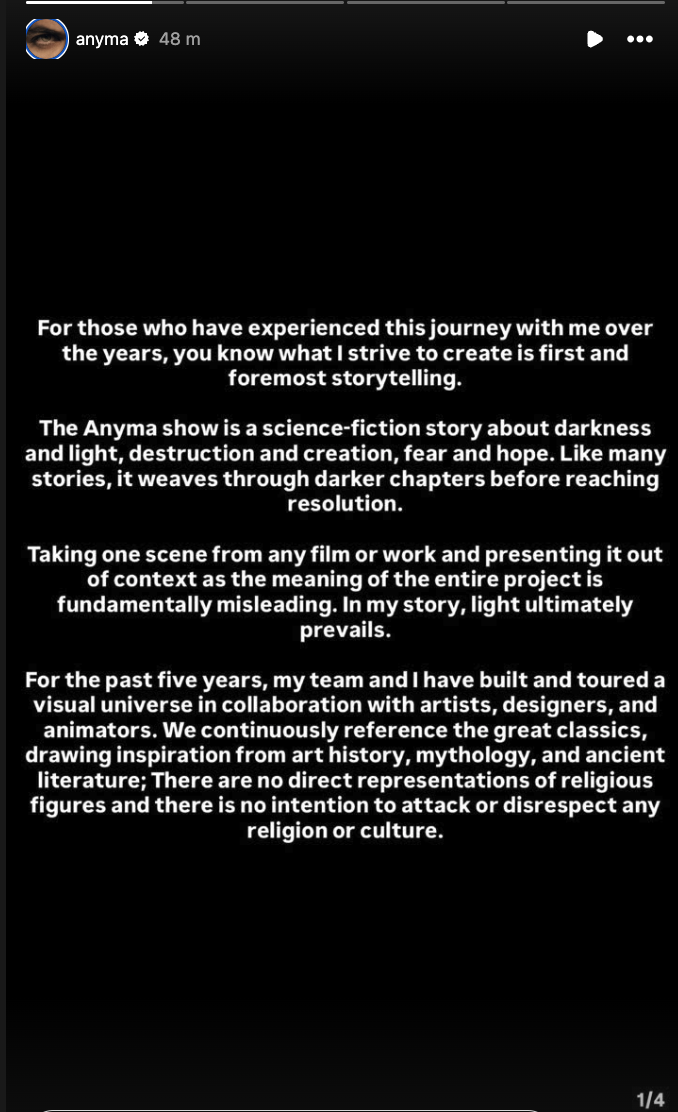
In a lengthy statement shared via Instagram Stories following the cancellation, the artist said selected moments from his show had been taken out of context and manipulated with AI to create what he described as a “false sinister narrative”, while stressing that neither he, his team nor the promoter had been given a meaningful opportunity to address concerns before the event was called off.
Reports that the Istanbul show had been cancelled first began circulating across social media and several news outlets on 2 September. In the lead-up, digital characters and imagery used in Anyma’s performances had been characterised by some social media users as containing “satanic symbols” and “rituals”, prompting calls for the event to be cancelled.
As reports of the cancellation spread, the absence of a public announcement on the Istanbul Governor’s Office website or social media accounts initially created uncertainty over the status of the event.
Emin Gokcegozoglu, head of press and public relations at the Istanbul Governor’s Office, subsequently confirmed the cancellation to Turkish fact-checking platform Teyit. Gokcegozoglu said the Governor’s Office would not issue a separate public statement and attributed the decision to alleged “satanic elements” in the artist’s performances.
The show, scheduled to take place at Ataköy Marina Arena on 12 September as part of Anyma’s 2026 ÆDEN world tour, was officially confirmed as cancelled by promoter Only You Live following two days of uncertainty. The promoter also announced that ticket refunds would begin from Monday, 7 September.

Addressing the controversy for the first time, Anyma — the solo project of Matteo Milleri — said storytelling sits at the heart of his audiovisual performances, describing the show as “a science-fiction story about darkness and light, destruction and creation, fear and hope”.
“Taking one scene from any film or work and presenting it out of context as the meaning of the entire project is fundamentally misleading,” Milleri said. “In my story, light ultimately prevails.”
He added that the visual universe developed by his team over the past five years draws on art history, mythology and ancient literature, and denied that the work contains direct representations of religious figures or is intended to attack or disrespect any religion or culture.
Milleri has now directly challenged the material circulated as part of those claims, saying darker moments from the production had been removed from their original context, altered using artificial intelligence, paired with different music and shared online.
“Let me be clear. None of my visuals are AI-generated and the greatest irony is that AI was used to alter my work by those who condemn it and they ultimately turned it into something to fit their own narrative,” he said. “My art was turned into social media and political propaganda. What happened next is unacceptable...”
In his response, Milleri also criticised the process leading up to the cancellation, saying there had been no opportunity for discussion with either the artist or promoter.
“Neither my team, the promoter, nor I received any meaningful warning or opportunity for dialogue before the show was cancelled,” he said. “Nobody asked us to explain the work, provide context or discuss possible adaptations. We were and are ready to do so.”
The artist said his team had previously performed around the world while engaging in dialogue around local cultures and customs, adding that they would have been willing to take the same approach in Turkiye had concerns been raised with them directly.
“We intend to appeal the decision and will continue trying to find a path back to Turkiye and to the Turkish people,” Milleri said. “Our channels remain open and we are willing to meet with the necessary authorities, explain our work, and provide its full artistic context.”
Anyma’s dystopian characters, robotic figures and surreal imagery have long formed part of an audiovisual language combining electronic music, technology and digital art. Interpreting those elements outside their wider narrative as “satanic” and cancelling an international tour date on that basis raises broader questions around artistic expression and the boundaries of administrative intervention in cultural events in Turkiye. The lack of a publicly issued decision setting out the reasoning in detail also leaves unanswered questions over the concrete criteria used to prevent an event attended by thousands of ticket holders and carrying significant economic implications.
The decision follows a number of other recent interventions affecting international concerts in Istanbul. In February 2026, scheduled performances by Slaughter to Prevail and Behemoth at Zorlu PSM were prohibited by the Istanbul Governor’s Office on the grounds that they were incompatible with “societal values” and had prompted objections from sections of the public. The decision resulted in concerts, festivals and other ticketed events at Zorlu PSM and Zorlu Center being suspended for two days.
In September 2025, Enrico Macias’ scheduled concert at the Harbiye Cemil Topuzlu Open-Air Theatre was also prevented from going ahead following calls for protests over the artist’s stance on Israel. At the time, the Governor’s Office imposed a one-day ban on events in and around Harbiye, citing concerns that potential demonstrations could place participants at a legal disadvantage and result in grievances.
Against that backdrop, the cancellation of Anyma’s Istanbul appearance has renewed questions around the growing influence that social media campaigns and objections from particular groups can exert over international concerts, as well as what such decisions could mean for Istanbul’s position on global touring routes and promoters’ ability to operate within a predictable live events environment.